Showing posts with label Moa Village. Show all posts

03 September 2011

Mamas of Moa

Now an ode to the Mamas.  The Mamas are the backbone of Moa.  Interesting fact: They are named after their firstborn son, for example, Eliphas’s mothers name is “Mama Eliphas.”  They work 7 days a week, all day, nonstop.  Here is a little insight into the life of Mama Eliphas:  In the morning she prepares breakfast.  Then she washes dishes, cleans laundry with knuckle-rubbing strength that is amazing to watch, and supposedly, wear.  Then she might do some farming.  Or perhaps go to the store that she runs where some staple items are purchased.  Then she’ll harvest some things for lunch and dinner.  She might also be husking corn—she showed us a small storage room with husked corn piled about 3 feet high which will become maize.  She might tend to the goat or chickens, clean or haul water.  One day we see her coming back from an outing—she is part of a special mama’s group (they even have matching bright orange tee-shirts) where pressing issues of the village are discussed.   She seems to take joy in these groups and in singing with the church choir.  Boy can they sing!

She cooks meals with 2 pots and 1 pan alternating them over one coal fire.  Needless-to-say we felt a bit of guilt about our array of wedding registry gifts.  Since water is scarce, the dishes are done the same way the laundry is done—in two buckets—one with and one without soap.


Mama's Kitchen, Eliphas at the healm

Maria sees many of the mamas on her clinic days with neck and back pains. She treats them with massage and sesame oil.  It is no wonder they have such pain---you should see the heavy loads that these women carry on their heads! And they all seem to bend at the waist instead of the knees.

I can’t help but think how such simple things like a refrigerator and a proper toilet would change their lives.  As you could probably imagine Maria sees a lot of water and food borne illnesses as well. I guess they first need consistent electricity---there is some talk about utilizing solar power…hmmmm….

02 September 2011

Balancing Act

Before we leave Moa Village, just a few pictures of how graceful the local people are and how very ungraceful us muzungus are.  Eliphas went from standing position to sitting position back to standing with a full bucket of water on his head!

Local woman carries a tree home for something important

Village children watch as Josh does not exactly feel where the water is waving above his head

Nicole tries to balance the bucket of water but is too concerned about a potential cold shower

Maria from Portland has the white man's burden of no balance too

01 September 2011

Moa’s Birthing Center

Currently, the nearest clinic is a 45 minute walk to Kadaia which is down the slope of Moa and up the slopes of Kadaia.   It is mostly a narrow footpath, and partly a wider dirt road on the flatter portions.  Pregnant women from Moa who decide to make the trek to Kadaia will often give birth unattended on the way over.  I can only imagine what that walk is like in the rainy season.


Pictures of the footpath between Moa and Kadaia villages

The Moa community decided among themselves that a birthing center is their highest need.  With government support they started to build one in 2005 but ran out of funds the following year.  A few months ago the community received 40m TZ Schillings ($25,000).  They are now mid construction and hope to have it complete in a few months.

Speaking of construction, the men working on this project were in sandals and did not wear hardhats.  If there is scaffolding, it is built from tree logs, which is probably why we don’t see many buildings over a few stories tall.   Considering the limited supplies, construction moves along quickly (when there is funding).  Workers usually come from neighboring villages and want to get home before dark.  We surmise that there is no “overtime pay” because the men seem eager to get done and started on the next project.

 Questions left to be answered:
  • Who will staff the Moa clinic and birthing center?
  • How will they fill the shortfall in skilled personnel?
  • Who will fund health worker training and payment?
  • How can we help in a sustainable way? The villagers flock to the clinics when they hear that muzungus are working there, but what happens when they leave? Things that might be help…..  Easy infant resuscitation training manual
    • Midwife/Emergency OB course
    • SUPPLIES!
    •  A local translator

 Construction work on the Moa clinic continues

Hike from Moa to Kadaia

We went on a hike down through Moa and up, and down again, through Kadaia, the neighboring village.  Eliphas was our fearless guide. What should have taken us 1 hour took 2 because of how many times we had to stop to greet people.  I was overcome by a feeling of appreciation for these hard working people eager to welcome us into their community.

We passed by one cement house with an adjacent mud hut.  The cement houses are becoming more the norm in Africa, the Simba Cement Company might be a wise investment.

Our walk meandered through Kadaia market where us muzungos paid a few dollars to gain access to the waterfall on the other slide of the Kadaia slope.  The fall was beautiful.

 Kadaia market

 Team Nosh at the waterfall at the bottom of Kadaia Village

On the walk we learned that Eliphas was once a porter for Kilimanjaro climbs.  He would carry 20 kilos, walk faster than the paying hikers, set up the camp before they got there, and then get paid whatever the guide felt like divvying up to them.  Things are a little better now as tourists will pay their porters personally.  Yet another example of how Tanzania’s tourist business has room to improve.  I do think it is heading the right direction, as the big outfits might price themselves out while smaller ones claim a larger portion of the clientele, but it is a slow process.

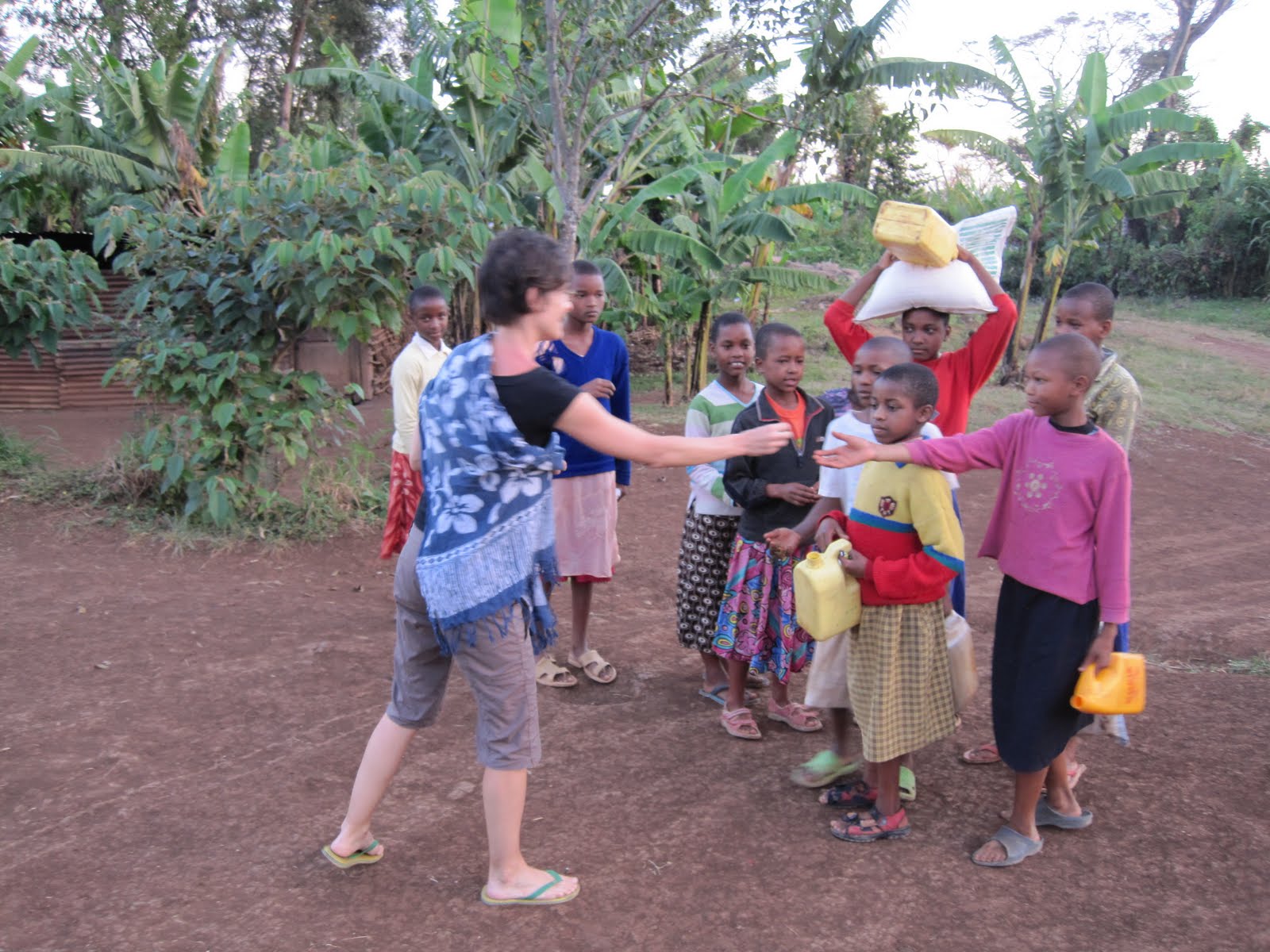
Before dinner, as the sun was setting, the ol’ Frisbee found its way out of the backpack.  Eliphas is a real natural and picked up the forehand flick throw very quickly.  Another friend of his joined in the fun as the three of us tossed it until it was dark.  The kids came out, seemingly from the woodwork, to watch.  However, when I tried to loft it in their direction, some would run.  We gave the few brave ones a chance to throw it.  The teenage girls were really into it and may have been the best of the villagers.  I think everyone had a memorable moment as we all chased the flying disc all over the pasture.

Nicole hands out candy as the boys play Frisbee, we can see who the kids liked better

For dinner, we helped mama make chapati, a flatbread made over a coal fire in a cast iron pan.  It was a process--every dinner takes so long to make.  Mama loved us, and wants us to come back, perhaps we will after our three months working in Kampala.

Team Nosh cooking chapati with Mama Eliphas

 Eliphas’s little brother joins in the fun

The Children of Moa

We are greeted warmly by many people, especially the kids, though they are initially shy but obviously curious.  We respond with smiles and rudimentary Swahili we have learned.  Immediately barriers are broken.  Soon we are all smiling and laughing.  You would think that Josh was the next Jerry Seinfeld the way the kids are laughing at his funny faces.  We are clearly the talk of the village.

Eliphas is the eldest of 7 (same father, different mother—apparently very common here) and the two youngest were home.  During dinner preparation the two boys (ages 4 and 6) were in and out of the house.  The saying “it takes a village to raise a child” must have originated here.  The kids—some no more than 1.5 years old—wander around unsupervised. They will spend days and nights with other families and eventually find their way back home.  The mamas seem to feed whoever happens to be around when dinner is ready.

There are no toys.   The only “toy” to speak of at the house we are guests at is a car made by one of the children out of garbage.  There doesn’t appear to be any discipline and there is no bedtime.  When I asked Eliphas if the children are ever scolded he said “No—I’ve never heard of that.”  “Only the teenagers who smoke the Bob Marley cigarette—sometimes the mamas think that is disrespectful and they get mad.”  Though, in school it is a different story.  When Eliphas was in middle school he was the class clown and was hit by a ruler many times.

Although there is very little job opportunity or likelihood of social mobility the village of Moa is unique in that they make school a priority.  Small fees are collected for tuition and all children are required to go to primary school.  Very few go on to secondary school—we heard 7%. The kids love school.  Many walk 45 minutes through mud and up and down hills to get there.  Since alarm clocks don’t exist kids will wake their neighbors up.  The mamas are too busy with too many other things to be bothered getting the kids up and off to class.  Sadly, the education is poor.  The English teacher speaks very little English.  The kids learn basic phrases through rote memorization—“Good morning m’am,” seems to be the most common (even in the afternoon or evening).  Eliphas repeatedly told us that the two things most needed in Moa are better education and better health care.  

Moa Village

We made a turn off the main road—or double road, because it has two lanes in both directions—in Moshi and headed up a bumpy red, dirt road to Moa.  We were traveling and staying with Maria whose friend Eliphas greeted us in the green and lush village of Moa.

Eliphas is 27 and met Maria in a coastal Tanzanian town called Tonga, where she arrived in Africa.  He is a project manager for an organization that brings volunteers from all over the world to build schools and help the local African community.  He escorts them from the airport, delegates their tasks, and sleeps where they sleep.  Because he can speak English well, Eliphas is a great person for this role.  His English has a British twang to the standard Tanzanian accent we have become accustomed to.  He wears a blue Manchester United football Jersey with ELIPHAS printed on the back.  There is a certain air of British to him. On his head is a green puffy knit cap with a small brim under which you usually see dreadlocks.  His hair is short though and sort of spiked.  Eliphas is a thinker and has many ideas about how to make his village, family, and himself prosper.  There aren’t many who think like he does in his village because the people are focused on how to get food into the bellies of their children.  His mother yelled at him the previous night because she saw him sitting pensively: “You think too much!” she said to him.  “It’s all right mama, I will be ok.”  His big plan is to organize tours to his village.  It is so close to Moshi where people leave for both safaris and Kilimanjaro climbs that the clientele is there.  While it is a smart idea, we fear the unintended consequences.  In other towns where businesses have been made on tourists paying to watch tribal people dance, cook, make machetes, there is something unsettling—a fine line between innocent curiosity and exploitation.  We conclude that since Eliphas is loved and respected by his village people this could be done in a respectful and mutually beneficial way.

 Eliphas teaches us how the ancient skill of balance works with a bucket full of water!

The people of Moa are blessed with incredibly fertile soil and are able to survive mostly on their crops.  Coffee, a big African export, grows wild here. Initially the Moan people tried to grow and export this crop but since the government pays very little for it, they razed the coffee plantations and stick mostly to subsistence farming. Much of the world’s coffee is grown in Africa, yet it is near impossible to get a decent cup here.  Breakfast is usually served with a small container of instant Africa coffee grounds.  And we were advised to be careful when ordering coffee, because in Swahili the word coffee means to slap in the face.

They have plenty of banana trees (initially imported from Brazil) all along the hillside. Property is divided by a certain type of tree branch--big leaves are placed starting at the road and through the property divide.  We can’t help but think that each family is literally one drought/flood/illness away from starvation, and fights over property.  Yet, the overall feeling in Moa is not one of sadness.  In fact, a walk through town is nothing but miles of smiles on the villagers’ faces.  We were definitely a novelty and since we arrived with Maria who the village people LOVE, we were quickly accepted. 

Moans can either live very short or very long lives.  The first morning of our stay the church bells rang from 5:00am to 5:12am to notify the villagers that someone had passed, a 47 year old woman.  However, Eliphas’s grandfather lived until he was 120 years old.  There are many who live to that age that Eliphas knows of, but we never see Al Roker wishing them a happy birthday.

Moa got electricity in 2005 but it is still spotty and it’s common for the power to be off for 12 hours and then on for 12 hours.  Only half the village’s residents get electricity, depending on the side of the village they live in.  Most people live in mud or cement dwellings, do not have running water, and use an outhouse (or drop toilet) for bathroom facilities. The families with income get their money from the father or children who work in Moshi or nearby Arusha, not from labor performed in the village. 

The eve we arrived in Moa we were served an authentic village dinner prepared by Eliphas’s mama.  We ate in the family/dining room.  The square room consists of two wooden chairs with floral patterned cushions opposite a couch of the same design along the wall with a coffee table between. A TV in the corner, of which there is no volume control, blasts local music videos or animal planet episodes from DVDs.  We sipped chai before the meal was served.  The meal was perfectly cooked rice, tomato sauce with “organic” beef, green pepper, onion, carrot, and ginger.  There was also the best tasting avocado to complement the dish; it was like avocado-flavored butter.